Lake Bratan is Bali’s second largest lake and a peaceful retreat away from the beer-swilling hordes who stay in Kuta and other places in the south of the island.
It’s cool up here as the lake is over 700 meters above sea level but, to be honest, it’s a bit of a disappointment overall and not a patch on the much more spectacular Lake Batur, which is not that far away.
The problem is that there is simply not that much to do! Yes, you can walk around the lake, and perhaps if you’re daring (or foolish), try to rent one of the boats – although the astronomically high price demanded will probably put you off. Still, it’s nice to get some fresh air in your lungs – especially if you spend most of the year living in a large city like I do.
Located on the west side of the lake, however, is one of the most iconic of all Bali temples – second only to Tanah Lot.
It’s called Pura Ulun Danu Bratan (Lake Bratan Temple) and gives the impression to the causal observer that it is actually floating on the water. It’s pretty old, being built in 1633, and it may come as little surprise to learn that it’s a tribute to Ida Batara Dewi Ulun Danu, the goddess of the lake.
Besides Lake Bratan, there are two other lakes in the area: Lake Buyan and Lake Tamblingan, and if you have a liking for flowers and plants, there are also some botanical gardens nearby.
Although it’s not really worth staying here, the area around the lake (called Bedugul) is certainly worth seeing if only for its natural beauty.
And getting here is damn easy. All you need is a decent map and reasonable navigation skills and you can’t really go wrong (but don’t blame me if it does).
From Denpasar in the south, you’re looking at an hour and a half journey on the main road which connects south to north Bali. From Lake Bratan you can continue your journey all the way up to Singaraja, and perhaps then to the laid back Lovina beach which is nearby.
Uluwatu is a large limestone peninsula, connected to the rest of Bali by a narrow stretch of land just south of the airport.
It’s a dry place, best known for: 1) its rugged coastline and surfer beaches; 2) a bizarre statue which, if ever completed, would be the world’s largest; and 3) a wonderful temple which teeters precariously on high cliffs with rocks and boulders far below.
One slip, and you're a goner.
And it’s also become popular among extremely affluent tourists looking for secluded and luxurious accommodation in Bali.
They stay at places like Alila Villas Uluwatu, a “postmodern clifftop resort” which features one of the world’s most decadent swimming pools according to The National.
But I bet the owner of the Alila Villas has now got out his map and is anxiously trying to gauge how far the villas exactly are from the sacred Uluwatu Temple.
Because if it’s less than 5 kilometers he might be in some trouble:
Bali Governor I Made Mangku Pastika has issued an order to demolish buildings not complying with a 2009 Bali bylaw on spatial planning that banned commercial structures within five kilometers of sacred sites.
Pastika’s order would affect 25 hotels, villas and restaurants built near Pura Luhur Uluwatu, a temple in Badung district.
Oh well.
As for the temple itself, it is well worth a visit even if it is overrun with some of the most aggressive and light fingered monkeys (actually long tail macaques) this side of the equator.
These thieving little blighters have no shame and will try to nick any thing you have. Including sunglasses.
Unlike Besakih - where aggressive touts prevail - Uluwatu still maintains its sanctity and you only have to pay a small charge (Rp 6,000) to get in – thankfully free from any hassle or attempted extortion. You will need to be properly dressed to enter, however, although sarongs and sashes can be rented at the temple’s entrance if you don’t bring them yourself.
The temple is one of Bali's nine key directional temples and most of it was built under the watchful eye of the Javanese sage, Empu Kuturan, way back in the 11th century.
It’s all pretty spectacular – provided you don’t suffer from vertigo of course.
The best time to visit is late afternoon when it’s cooler and, if you’re lucky, one of the best spots in Bali – and probably the world – to witness a truly spectacular sunset.
Well, well, well. Jakarta’s Potato Head has made it onto the international scene by getting a review in that most illustrious of American finance rags, The Wall Street Journal!
And it’s a pretty good review too! Sure not perfect - but good enough nonetheless to swell Potato Head’s head to some humongously large size, or, barring that, make steam come out of its ears!
The review lauds Potato Head’s “gastropub favorites”, giving praise in particular to the clam chowder served over a buttery puff pastry (55,000 rupiah), the grilled wagyu beef burgers (120,000 rupiah), and the baby pig casserole (120,000 rupiah) which features “tender baby pig” with crispy cracklings and imported white bean stew.
The restaurant also gets kudos for its deserts, which like a beautiful and sexy woman, are almost impossible to resist.
Who could say no, for example, to the warm sticky toffee date pudding (55,000 rupiah), a simply wonderful indulgence which is “unfussy, sweet and rich, complete with a scoop of vanilla ice cream”?
The Wall Street Journal also pine on Potato Head’s inventive cocktails:
…which include a margarita sourced to a 1937 London cocktail book, and a punch made with Potato Head’s own vanilla-infused tequila.
“Of course,” the Wall Street Journal goes on to add, “none of that really helps much at lunchtime, unless you’re planning to take the rest of the afternoon off!”
Personally, Potato Head is a bit too pretentious for me and while the food is good, much better value can be found at say Zenbu, or, if you’re looking to really stuff yourself like a bag of potatoes then nothing can beat the buffet at Satoo in the Shangri-La!
Potato Head
Jalan Jenderal Sudirman, Kav 52-55
Pacific Place Mall, No. G51A
Jakarta
Tel: 62-21-5797-3322
“No culture can live, if it attempts to be exclusive.”
>Mahatma Gandhi
Nusa Dua is a “gated” resort area in South Bali where well-heeled holidaymakers are pretty much guaranteed that they don’t have to rub shoulders with the local riff-raff – other than those employed at their luxurious 5 star hotels of course.
A pretty bizarre notion I’m sure you’ll agree. After all, isn’t travel supposed to be about opening your mind to other ideas and cultures rather than seeking isolation and detachment from the world around you?
And this, remember, in possibly the most cultured island in the world! Why would anyone want to be isolated here?
So how did this ever happen?
Well, it all goes back (inevitably) to the rent seeking ways of former president Suharto who connived with international hotel operators to transform this once pretty-much deserted and tranquil part of Bali into the upmarket holiday haven it is today.
The Balinese protests fell on deaf ears at the time and gargantuan hotels were built which - in some cases - were mighty close to violating the Balinese customary law that no buildings should be higher than a palm tree.
Worse still, access to the Nusa Dua beaches was also restricted by the huge hotel compounds – a matter of vital importance to the Balinese who need access to the sea since that is where the ashes from cremation ceremonies (called Ngaben) are finally released.
But such matters do not trouble the tourists who have far more pressing concerns like working on their tans. And where better to do this than on the “private beach” in front of the hotel?
Life’s a beach.
NB: Not so far away from Nusa Dua, a huge resort (called Pecatu Indah Resort) is now being built on 400 hectares of land.
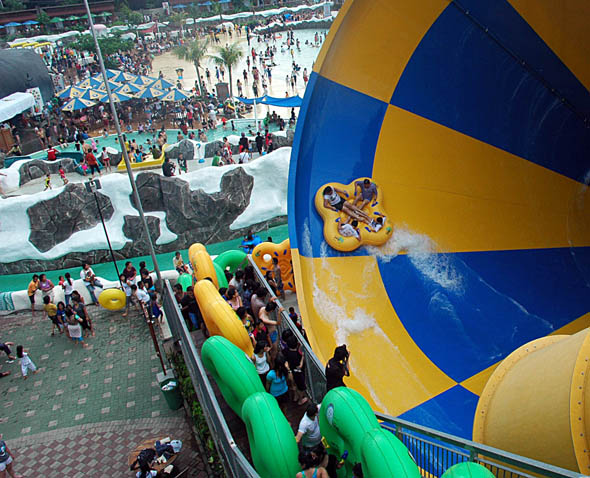
Its main feature is a waterpark with its own supply of desalinated seawater:
Made Putrawan, president director of Bali Pecatu Graha, the developer in charge of the resort, said that the desalination plant for the newly opened waterpark would also serve other facilities in the resort area.
He said these included the New Kuta Condotel, a 278-room hotel, as well as the New Kuta Golf Course, site of the 2009 Indonesian Open, and the Kelapa nightclub.
Its owner?
None other than Tommy Suharto.